Jeremy Dwyer-Lindgren for JetTip
Looking out the window of the plane, two colors dominate the view: white and blue. They're the only two discernible colors I've seen since we departed Montreal two hours ago, having climbed up and over the persistent gloom that had hung over the city during my two days in town.
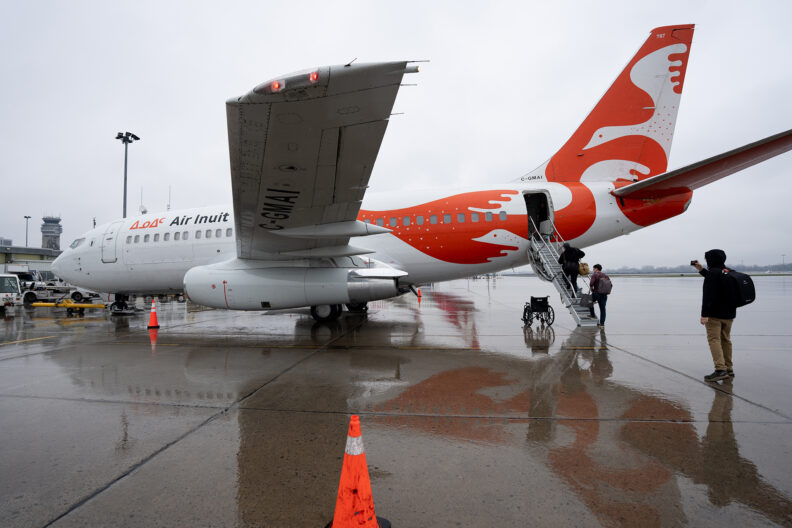
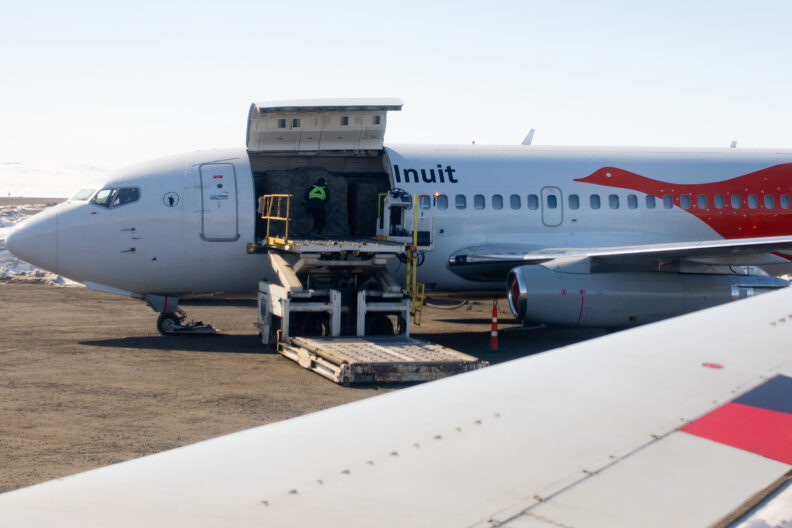
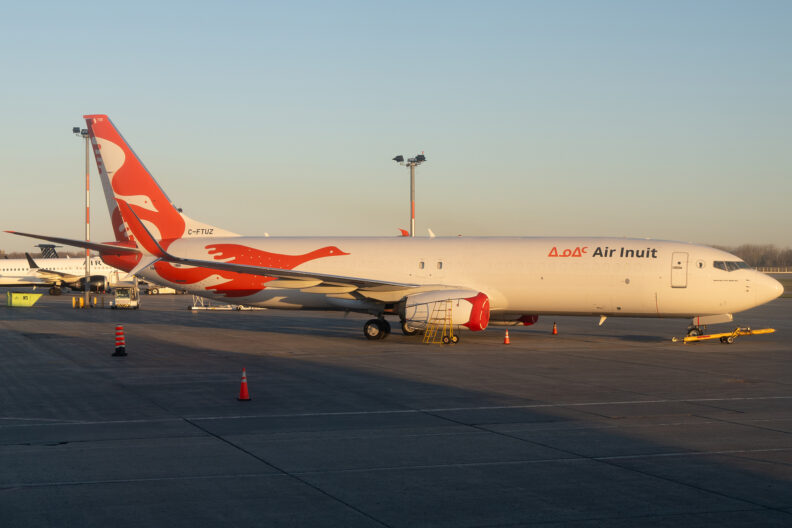
Today's destination is the small Inuit village of Puvirnituq, located deep in the remote northern regions of Nunavik (Quebec), Canada. Today's jet, an Air Inuit Boeing 737-200 combi, currently cruising along at FL310. Or at least that's what I thought.
Jeremy Dwyer-Lindgren for JetTip
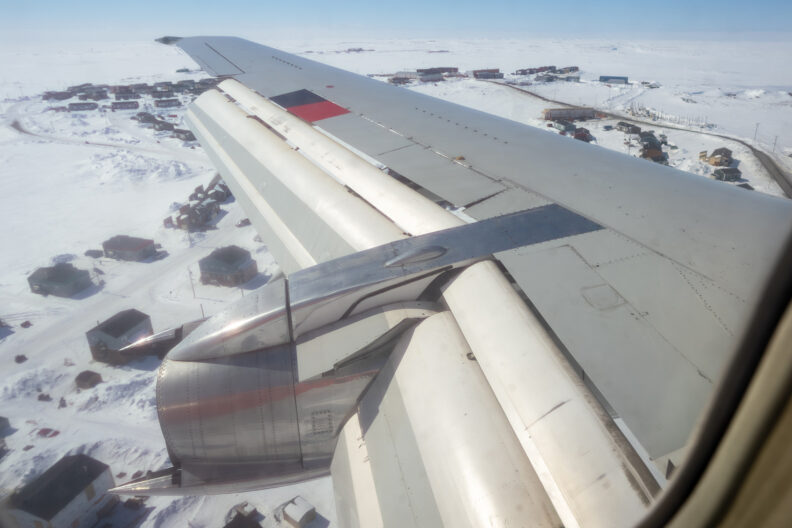
It wasn't until several dark features on the ground revealed themselves to be rock formations that I realized the clouds had likely dissipated a few hundred miles back. What I'd been looking at since was the seemingly formless, unyielding bright white of the tundra. The difference between the two had been so slight that I'd failed to notice our gradual descent until we were practically on the ground.
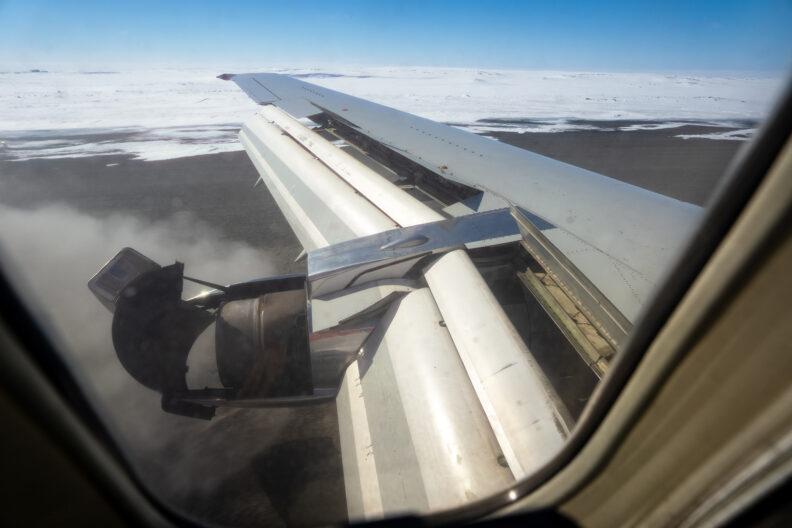
An announcement from the captain, followed by the deployment of the flaps, confirmed that landing was imminent. A few minutes later buildings began to dot the horizon, the edges of the village appearing seemingly out of nowhere. Before we knew it, the jet firmly planted onto the runway. The classic 737-200 clamshell thrust reversers deployed beautifully, kicking up a thick grey cloud.
Jeremy Dwyer-Lindgren for JetTip
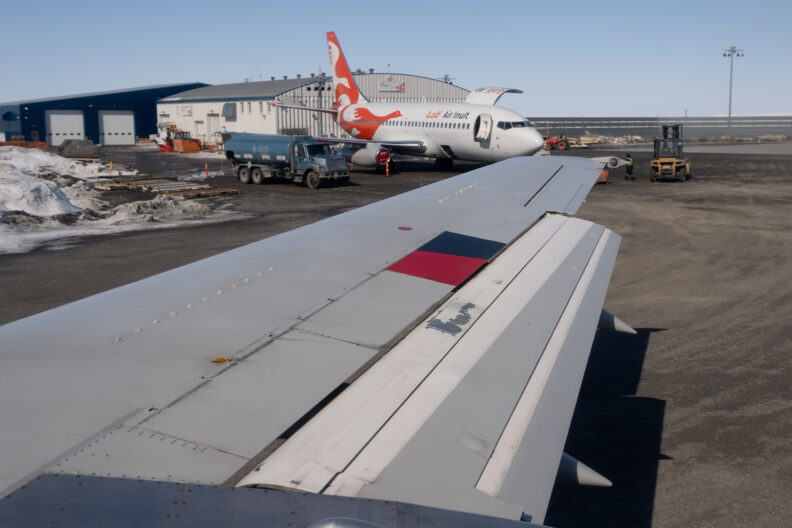
The cloud follows the airplane as the pilot pulls a U-turn at the end of the runway, backtracking the length of it before arriving at the small terminal. As soon as I step off the built-in rear airstairs onto the apron I can feel the light crunch of loose rock under my feet. By the time I make the short walk into the terminal, my shoes are covered in the same grey dust we kicked up on landing.
Welcome to Puvirnituq, located in the far-north regions of Quebec on the eastern shore of Hudson Bay. The town is over 1,000 miles due north of Montreal, as are many of the other villages in the region. Few of them connect via road to one another, and none of them connect at all to the big cities to the south.
That means the airport, which lays claim to the longest runway in this part of the province by a wide margin, is a critical lifeline to Puvirnituq and the surrounding communities. It is the only runway in the area that can safely handle jets, the next closest jet-capable airport being 343 miles to the east.
Jeremy Dwyer-Lindgren for JetTip
Something about it, though, is not quite normal, and the evidence is still coating my shoes. An astute observer would’ve noticed evidence while landing too, that big grey cloud of dust. You’d be forgiven for thinking it was just a really dirty runway, but it isn’t a normal runway at all. No, this one is made of gravel. In fact it is one of the only such runways in the world that still operates scheduled jet service, making it very rare.
It seems only fitting then, that a runway of such rarity be served almost exclusively by an airplane of equal rarity. And that is not an exaggeration. While there are literally thousands of Boeing 737s plying the skies today alone, the jet I flew in on is one of maybe twelve that can fly into or out of here. All of them are 40+ year-old -200 models, heavily modified to be able to operate safely on exactly this type of runway.
Jeremy Dwyer-Lindgren for JetTip
Even still, why is Air Inuit still using a model that went out of production in 1988? The 737 line has seen three entire evolutions since then. It'd be reasonable to assume that better options have come along since, but you'd be wrong. We'll come back to why later, but in the meantime, the next most obvious solution seems to be sitting just outside the window: the runway. Why not just pave it?
Well, it turns out you can’t do that.
For starters, consider where we are. Many of the unpaved runways still in use around the world, like this one, are located in very remote locations. They likely don't have road access to the nearest population centers, as is the case for the majority of Air Inuit's network. Everything from materials to machines to manpower needs to be flown in or made on site. Which, as you probably guessed, is extremely expensive.
Even if you could muster the funds to build one, sometimes nature just isn’t going to give you the W. Puvirnituq’s airport, and much of the town, sits atop the permafrost of the tundra. Winter frost heaves and summer thaw-outs can significantly alter the shape of the ground, resulting in uneven and ever-changing surfaces. Any paved runway would quickly begin to buckle and crack. Continuous maintenance work would be complex and costs astronomical.
And so the gravel isn't going anywhere.
For much of Air Inuit's fleet this isn't really a problem. There are about a half dozen airports in the region, and all of them have gravel runways too. Most of them are quite a bit shorter though, and thus limited to a steady stream of Dash 8s (100s and 300s) and Twin Otters.
The turboprops don't really care about the gravel. Their high wings and similarly high engine placement significantly reduce the odds of FOD ingestion. They don't care about short runways either, as both excel in STOL performance.
But most of them lack the range to make it to Montreal. I know, you're probably thinking “most” is a typo, but it isn't. Air Inuit operates one Dash 8-300 modified to make the 1,019-mile flight nonstop. It takes four hours on average, sometimes over five, all while cruising around FL210. That's a hard pass for me.
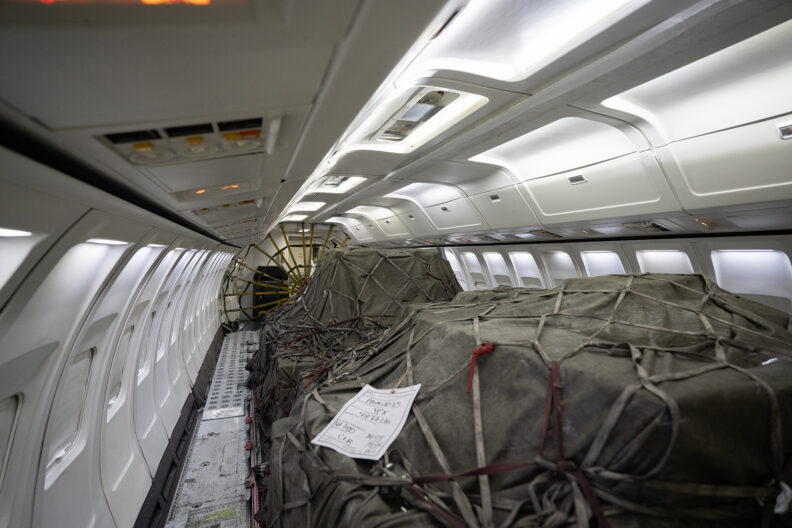
Even if they all could make the run, the turboprops still just aren't physically big enough. The 737 simply carries more. A lot more. Plus, Air Inuit’s -200s are known as combis. This sub-model enables operators to quickly split the main cabin deck between seats and palletized cargo in up to six different configurations for maximum capacity efficiency.
Jeremy Dwyer-Lindgren for JetTip
It does all of that with far more speed and way more comfort to boot.
And so the 737 isn't going anywhere either.
There's just one catch. The 737, with its low wing and even lower slung engines, really doesn't get along with gravel. Which brings us back to why Air Inuit is using a fleet of rare, 40+ year old jets to begin with.
It turns out they’re the only aircraft equipped to do the job, and it took an awful lot of modifications.
Back when the 737 first debuted in the late 1960s, unpaved runways weren’t as unusual. Customers operating in the high arctic began poking Boeing for a solution that would allow them to deploy the jet’s speed, comfort and capacity throughout their entire network.
Boeing delivered in 1969, providing customers an option for a ‘gravel kit’ that would enable them to operate aircraft on unpaved or improvised surfaces. While gravel is the most common, it also included certifications for loose dirt and grass.
The basic goal of the kit is to prevent foreign objects from ending up in places that they don’t belong. The modifications tend to split into two categories: deflect and protect.
Jeremy Dwyer-Lindgren for JetTip
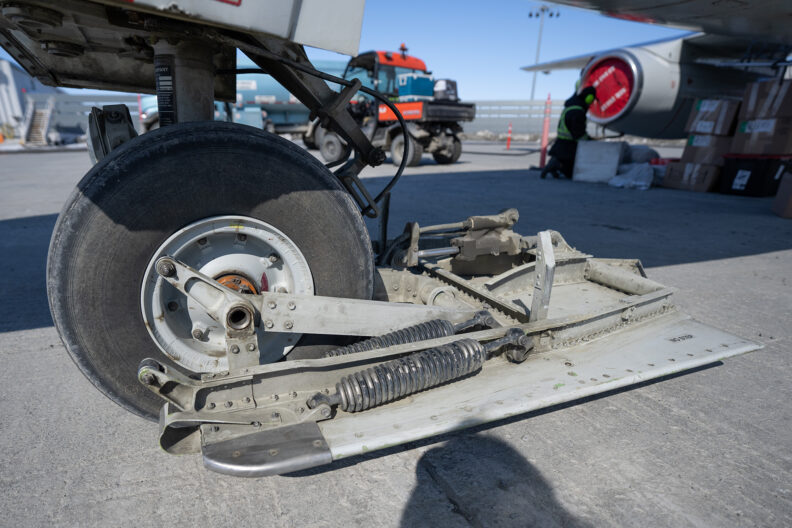
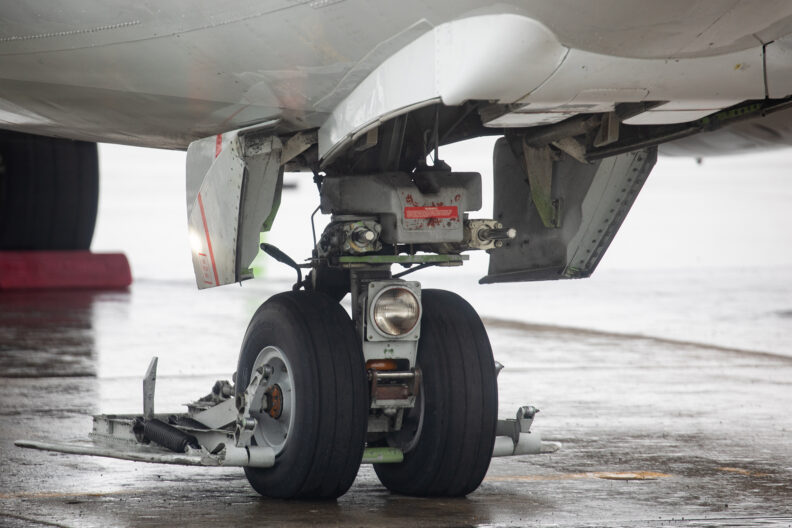
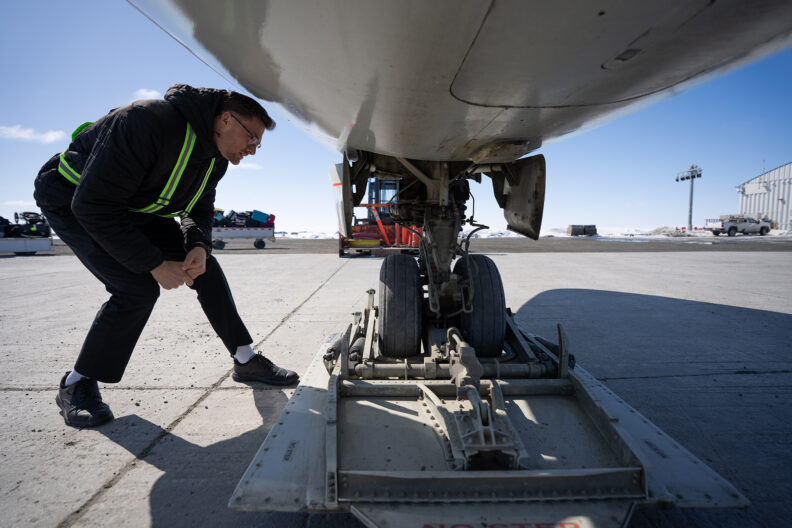
The deflect mods are easier to see. The biggest and most obvious is the nose gear assembly, which has what looks like a giant sled attached to the bottom of the wheels. The large plate sits a few inches off the ground and extends a few feet backwards to prevent rocks and debris from kicking up off the nose gear while underway. Due to the sled’s size, the wheel well is much wider and extends beyond the typical curvature of the nose.
Jeremy Dwyer-Lindgren for JetTip
Jeremy Dwyer-Lindgren for JetTip
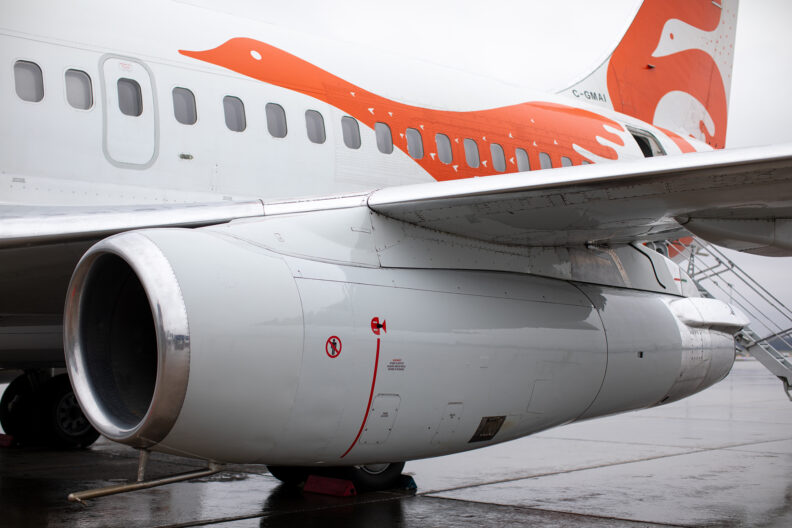
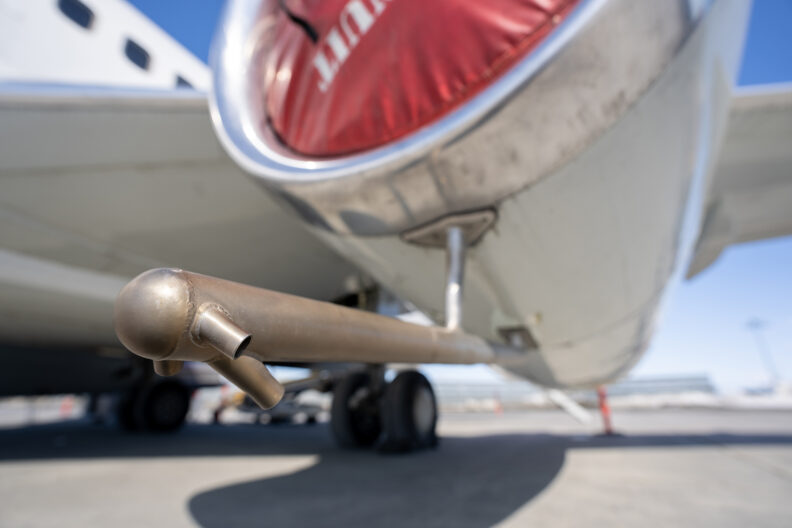
The next most obvious is the vortex dissipator, a small metal pipe that hangs below and extends out in front of each engine. Its job is to break up the naturally occurring vortices that engines form with the ground, which makes it very easy to pull in debris. It does so by forcing engine bleed air out of three fixed nozzles, which when combined together creates a cone of air pushing through the space vortices typically form.
Jeremy Dwyer-Lindgren for JetTip
As one of the pilots would later explain to me, this also necessitates that all of the bleed air from the engines be directed through these nozzles during take-off, landing and taxi. Cabin pressure, temperature and oxygen are pulled instead from the APU during these phases of flight.
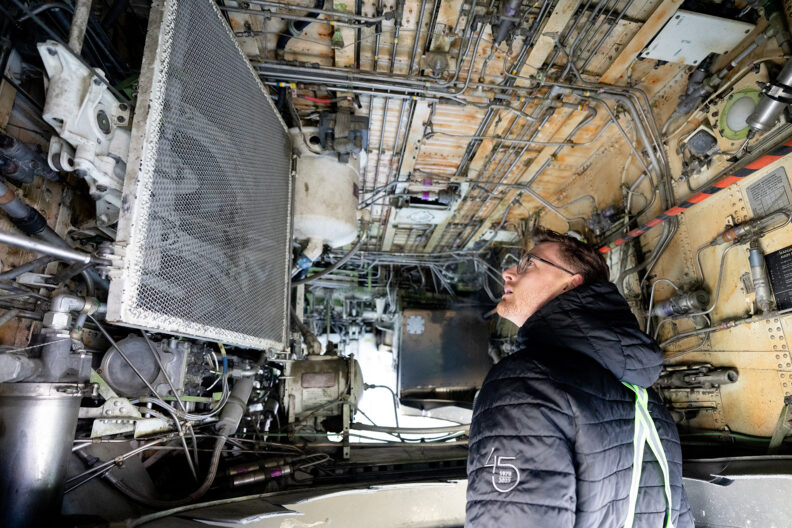
There are two more mods, though both are harder to see. The first is a small deflector plate between the tires on both sets of main gear. The other is another larger plate on the elephant ear fairings inside the wing, which otherwise become exposed when the flaps are out.
Jeremy Dwyer-Lindgren for JetTip
The protect mods are harder to see. While the deflector plates keep out a lot of debris, everything under the wings takes a beating over time. The flaps and underbelly are both reinforced with an abrasion-resistant Teflon coating. Protective metal shielding covers some of the hydraulics, brake cables and speed brake cables. The flaps are reinforced, and metal mesh screens around the anti-collision beacon and inside the main gear wheel well help prevent extra damage. On some models the underbelly beacon retracts altogether into the body.
Beyond physical additions, there’s also a handful of procedural changes. One is the pre-flight pilot inspection, which includes checking for debris but also for the accumulation of too much slush or mud. Both are common in the late spring and fall, when the runway is softer. If not found and removed, mud hiding around the sled could wind up going up into the wheel well and freezing the nose gear doors shut (yikes). Same situation with the flaps, which is also why they have their specific deflector (also yikes).
Jeremy Dwyer-Lindgren for JetTip
This all seems like a lot of time, money and effort because it is. And as mentioned earlier, you’d think newer better options would exist even within the 737 product line. But they don’t, because Boeing never offered the gravel kit beyond the -200 model.
That means the youngest aircraft that could possibly be gravel-kit ready would be 37 years old. Air Inuit's four-strong -200 fleet is even older, averaging over 45. The plane I flew in on was delivered in 1981, making it the youngest. The oldest in the fleet is the fifth oldest passenger-flying 737 on the planet.
As you might expect, parts are becoming harder to find and thus more expensive to source. The classic JT8D engines are extremely loud, prompting windows to rattle in airport terminals and decibel warnings to trigger on smart watches in the cabin (I’m not making that up, it happened to me on every takeoff). They're also terribly inefficient, burning way more fuel and spewing far more emissions than their modern counterparts.
So for as invaluable as the 737-200 has been in the high arctic, its time is coming to an end. Which means that Air Inuit is in a bit of a pickle in Puvirnituq.
They can’t currently serve the airport with other jets, and other jets can’t currently serve the airport. So what is Air Inuit to do?
If all goes well, the plan is to address both.
Jeremy Dwyer-Lindgren for JetTip
The first is the airplane. As the -200s retire over the next two years or so, Air Inuit plans to replace them with -800s. They’ve already purchased a few, and are currently having them converted over to combis (the first in the world). They’ll be ready, according to the airline, in the third quarter of this year.
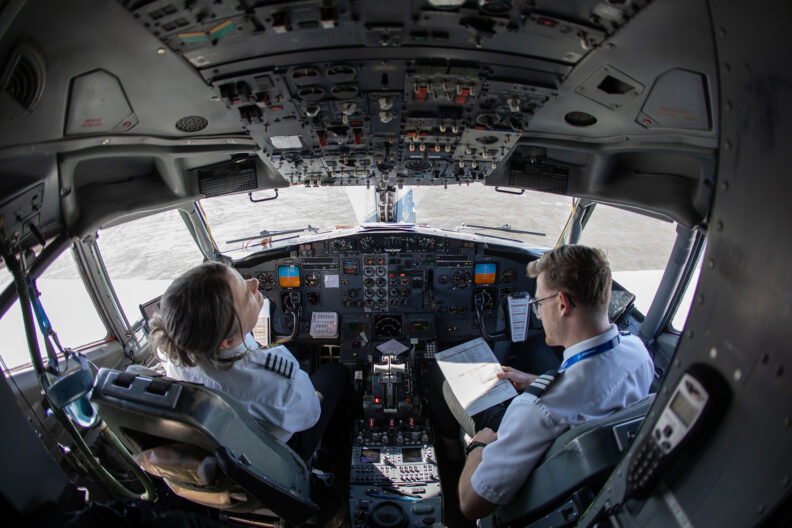
As you’d expect, the new jets will bring some serious upgrades. The -200s, at this point, are prone to breaking down. The -800s will be less so. They’ll be up to 30% more fuel efficient, way less noisy, and trade steam gauges for glass in the cockpit.
Jeremy Dwyer-Lindgren for JetTip
What the new airplanes will not have, however, is a gravel kit. Without it, they currently wouldn’t be able to land at Puvirnituq, but the Quebec government has a plan for that too.
They’ve been working closely with Ohio-based Midwest to certify a solution that would stabilize the runway. Basically the company adds a bonding agent to the top 4-6” of gravel that will bind and harden the surface. A top coat seal will provide additional resistance to deterioration, erosion, and generation of FOD.
This summer will be the first to deploy the solution and collect data, which will be generated largely by 737-200 movements. After two years of testing, Air Inuit and Quebec government are anticipating receiving approval to finally operate any jet at any time.
Back in the terminal, it’s already time to reboard and jet off to the next stop. As the plane taxis out to the runway, wisps of grey dust appear behind the engine. As we line up, the pilots throttle the engines up to a roar, a thick grey cloud forming behind us.
Jeremy Dwyer-Lindgren for JetTip

Jeremy Dwyer-Lindgren
Jeremy is a Pacific Northwest-based photographer and writer who specializes in all things airborne. He enjoys chasing down rare and unusual flying objects of both the mechanical and organic variety, with a particular penchant for four-engined aircraft and hornbills. His work has appeared in many outlets across the industry, as well as in the conservation community through his day job at Woodland Park Zoo in Seattle.
Recent Posts
NFL 2026 - week five team charter flights
NFL 2026 - week four team charter flights
NFL 2026 - week three team charter flights
SpotLAX+Dorkfest 2026 avgeek news and notes
NFL 2026 - week two team charter flights
News
JetTip Features, Trip Report, Special Liveries, Events, Politics, Press Releases, COVID-19
Airline
Delta, Icelanndair, Sun Country, UPS Airlines